But here’s the thing: not buying inventory doesn’t actually lower your food cost. All it does is set you up to run out of product, kill sales, and frustrate your team.

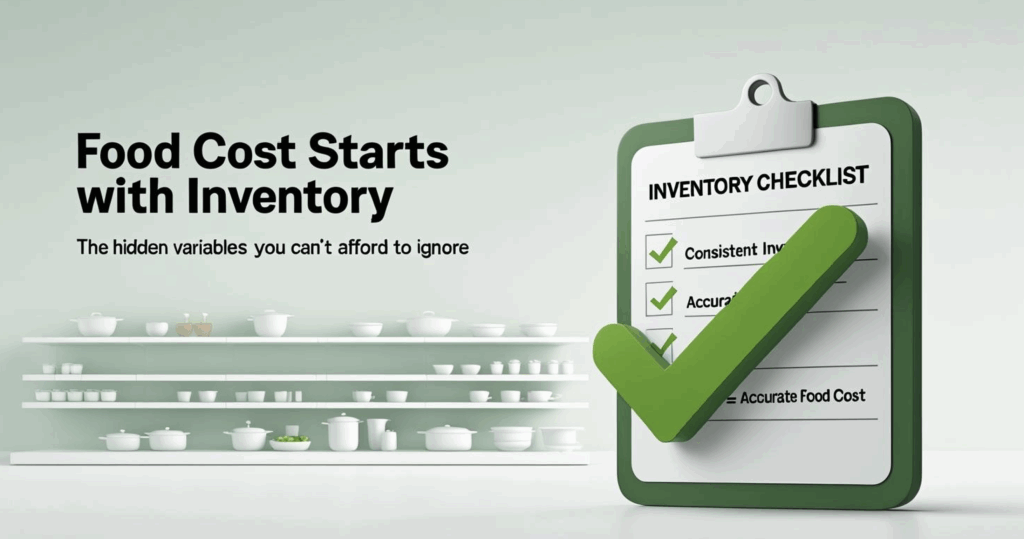
Let’s be honest—when food cost creeps up, the first instinct is often to blame waste, theft, or over-ordering. Sure, those all matter. But if you want to control food cost for real, you need to start with the basics: how you do your inventory.
Here’s why: Small inconsistencies in inventory—what you count, how you count, and even who counts—can throw off your numbers in ways that no spreadsheet can fix. One manager includes spices, the next skips them. Pricing is based on last month’s invoice, not today’s. Case sizes aren’t double-checked. Suddenly, you’re making big decisions on bad data.
The Hidden Variables: What Really Skews Your Food Cost
Let’s break down the usual suspects:
- Pricing mistakes: Are you using your current vendor pricing and the most up-to-date prices on all items? Is everyone using the same units, the same case sizes?
- Portioning: Is your staff serving the right amounts, or is “just a little extra” costing you big? Every extra scoop, slice, or ladle adds up over time.
- Waste and yield: Is your kitchen producing too much or too little? Are you tossing out more than you should, or running out at the worst time?
- Theft: No fun to talk about, but It’s real, and it’s often subtle.
- Consistency: This one flies under the radar. If your inventory process isn’t rock-solid—same items, same timing, same standards—your food cost numbers are just guesses.
Red Flag: If two managers can’t agree on what goes in the inventory, your food cost is already off before you start. Pro Move: Set clear rules for inventory—what’s counted, how it’s priced, and who’s responsible. Then stick to it, every single time.
MYTH BUSTER: “If We Just Buy Less, Our Food Cost Will Drop”
This one’s everywhere. When budgets get tight, the knee-jerk reaction is to cut back on ordering. But here’s the thing: not buying inventory doesn’t actually lower your food cost. All it does is set you up to run out of product, kill sales, and frustrate your team. As long as you’re ordering smart, the inventory you have at month’s end goes back into the calculation. What matters most is how you manage what comes in and goes out—not just how much you buy. Spending less on groceries doesn’t guarantee a lower food cost; it’s about tracking waste, portion accuracy, and above all, having a consistent, reliable inventory process.
Quick Insight of the Week
Stat: Industry data shows that inconsistent inventory practices can swing reported food cost by 2–5%—enough to turn a profitable month into a problem one.
Takeaway: Inventory Isn’t Just a Chore. It’s Your Food Cost Compass.
If you want to control food cost, start by controlling your inventory process. Decide what gets counted, update your pricing regularly, and make sure everyone is following the same script. It’s not glamorous—but it’s how you build a kitchen that wins on the numbers and the plate.
Try This: This week, audit your next inventory. Where are the inconsistencies? What’s one small change you could make to tighten things up?
Let’s Talk! What’s the toughest food cost challenge you’ve wrestled with? Drop your war stories and best advice in the comments—we’re all in this together.
Final Thought Managing food cost isn’t about magic tricks or drastic cuts. It’s about getting the basics right, every single time. Sometimes, the smallest changes in your inventory process make the biggest difference at the end of the month.
Thanks for reading this edition of Table Talk. Stay tuned for more practical tools, real stories, and fresh insights next time.